
Last Updated: 3 November 2026
Quick Summary
Structural compliance for rental properties means keeping the structure and exterior in repair under section 11 of the Landlord and Tenant Act 1985, and managing structural hazards so councils do not need to use their Housing Act 2004 enforcement powers. Any load-bearing change also needs Building Regulations Part A approval from a building control body.
- The HHSRS scores hazards on likelihood and severity, and a Category 1 hazard triggers a duty on the local authority to act.
- Appoint a building control body before structural work starts, submit engineer’s calculations, book inspections and get a completion certificate.
- Keep a hazard log per property recording date, location, hazard type, action taken, contractor and completion date.
- Store building control completion and regularisation certificates, engineer calculations and dated inspection photographs in a digital folder per property.
- Structural alterations carried out without building control approval can cause difficulties with an insurance claim or a property sale.
Table of Contents
- Step 1: Know Your Structural Duties Under the Housing Act 2004
- Step 2: Assess HHSRS Structural Hazards Before They Become Enforcement Issues
- Step 3: Meet Building Regulations Part A Compliance for Structural Work
- Step 4: Keep Landlord Building Regulation Certificates and Records in Order
- Frequently Asked Questions
Step 1: Know Your Structural Duties Under the Housing Act 2004
Structural compliance for rental properties starts with your legal position. The Housing Act 2004 gives councils powers to act where housing conditions pose a risk to occupiers; your duty is to keep the structure safe and in good repair.
The framework rests on two pillars: the Housing Act 2004 and the Landlord and Tenant Act 1985. Section 11 of the 1985 Act requires landlords to keep the structure and exterior in repair. That covers walls, roofs, drains and foundations.
Failing either duty can trigger enforcement action or rent repayment orders. Housing Act 2004 legislation sets out the council’s powers in full.
If you are planning alterations to meet these duties, explore our construction and renovation services for details of the work we undertake.
Step 2: Assess HHSRS Structural Hazards Before They Become Enforcement Issues
The Housing Health and Safety Rating System (HHSRS) is the risk-based tool councils use to score hazards, and structural defects feed directly into several of its 29 categories, most obviously damp and mould growth, excess cold, falling elements, and structural collapse.
Each hazard is scored on likelihood and severity of harm. A Category 1 hazard triggers a duty on the local authority to take enforcement action; Category 2 hazards give it discretionary powers (Housing Health and Safety Rating System (HHSRS): Enforcement guidance).
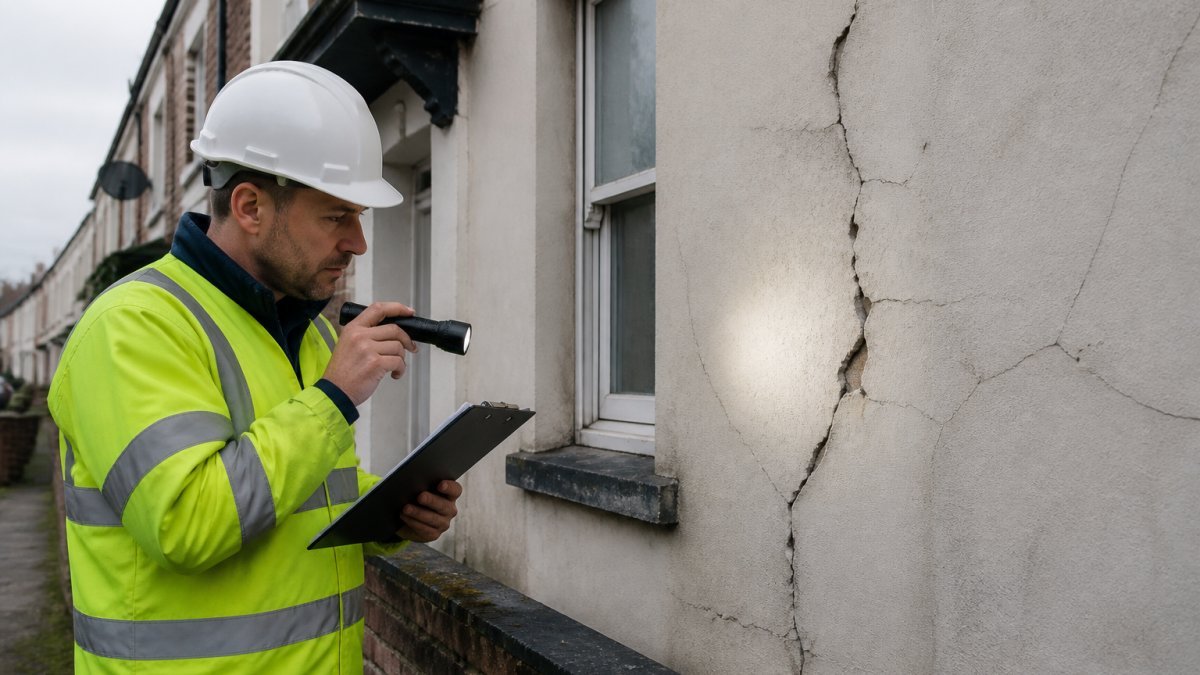
Walk every property and check for:
- Cracks in external walls, especially around lintels and above openings
- Sagging rooflines, slipped tiles or displaced ridge tiles
- Damp and mould linked to failed damp-proof courses or bridged cavities
- Uneven floors, sticking doors or windows that suggest movement
- Loose render, spalling brickwork or eroded mortar joints
- Defective rainwater goods discharging onto walls or foundations
- Loose or missing balustrades, handrails and guarding to stairs and balconies
Subsidence and foundation movement are the costliest to ignore: remedial work escalates from crack stitching and underpinning to full structural intervention the longer movement stays active.
A common mistake is treating the inspection as a tick-box exercise and recording nothing. If a council officer serves an improvement notice, your dated photographs, notes and contractor reports are the evidence that you identified and addressed the hazard promptly. Keep a simple hazard log per property, date, location, hazard type, action taken, contractor and completion date, and update it after every visit.
For HMO landlords, structural compliance sits alongside fire safety and licensing. Our HMO conversion service addresses these requirements together.
The hazard log you keep per property should capture these details after every visit.
| Log field | What to record |
|---|---|
| Date | Date of the inspection or visit |
| Location | Where the hazard was found |
| Hazard type | The defect or hazard identified |
| Action taken | What was done to address it |
| Contractor | Who carried out the work |
| Completion date | When the remedy was finished |
Step 3: Meet Building Regulations Part A Compliance for Structural Work
Building Regulations Part A compliance governs structural work (Structure: Approved Document A). Any wall removal, steel installation or load-bearing change needs approval from a building control body.
The process is straightforward if you plan it: appoint a building control body before work starts, submit structural calculations from an engineer, book inspections at key stages, and get a completion certificate at the end.
Removing a load-bearing wall without proper steel design is a false economy.
Watch out: skipping building control approval can void your insurance and leave you unable to let the property lawfully. For structural alterations, see our structural alteration services.
Step 4: Keep Landlord Building Regulation Certificates and Records in Order
Landlord building regulation certificates prove the work was done to standard, but their real value is evidential: they are what you reach for when an insurer queries a claim, a licensing officer asks for proof, a tenant disputes conditions, or a buyer’s solicitor raises enquiries.
A simple digital folder per property works well. Store:
- Building control completion certificates and any regularisation certificates for historic work
- Structural engineer calculations and design drawings
- Gas safety certificates and electrical installation condition reports
- Energy performance certificates and right to rent records
- Fire risk assessments and, for HMOs, licensing correspondence
- Dated photographs and contractor reports from every structural inspection
Structural alterations carried out without building control approval can cause difficulties with an insurance claim or a property sale, so regularising the work early is advisable.
Digital record-keeping pays off most in disputes. A dated hazard log, paired with the contractor’s report and the completion certificate, shows a clear trail from identification to remedy. Keep records for the life of the property and back them up off-site.
If you need help assembling a compliance file or planning remedial works, contact our team to discuss your project.
Frequently Asked Questions
What are the structural requirements for rental properties under the Housing Act 2004?
The Housing Act 2004 requires landlords to keep rental properties free from serious hazards, assessed through the Housing Health and Safety Rating System (HHSRS). Structural collapse, falling elements, damp and mould, and inadequate ventilation all fall within scope. Local authorities can inspect and, where Category 1 hazards exist, serve improvement or prohibition notices. Meeting structural compliance means acting on defects before an inspection forces your hand.
Do I need building regulations approval for internal alterations in a rental property?
Yes, in most cases. Removing or altering load-bearing walls, changing structural openings, or installing new foundations requires Building Regulations approval, particularly Part A compliance covering structure. Minor cosmetic work usually does not. Always confirm with your local Building Control body before work starts, because unapproved structural work can be ordered to be removed and can affect insurance and future sales.
What are the consequences of non-compliance with building regulations for landlords?
Non-compliant structural work can result in enforcement action from Building Control, orders to rectify or remove work at your own cost, invalidated insurance, difficulty obtaining a mortgage or selling the property, and in serious cases prosecution. For HMOs, licensing conditions may also be refused or revoked. Keeping landlord building regulation certificates on file shows compliance during audits and speeds up property transactions.
Structural compliance is not a box you tick once. It is an ongoing duty that protects your tenants, your asset and your licence to let. D&D Construction Services Ltd manages structural alterations and HMO conversions end to end, with engineering input, Building Control sign-off and a single accountable team from planning to completion. Get started with D&D Construction Services Ltd and put your compliance on a firm footing.
